


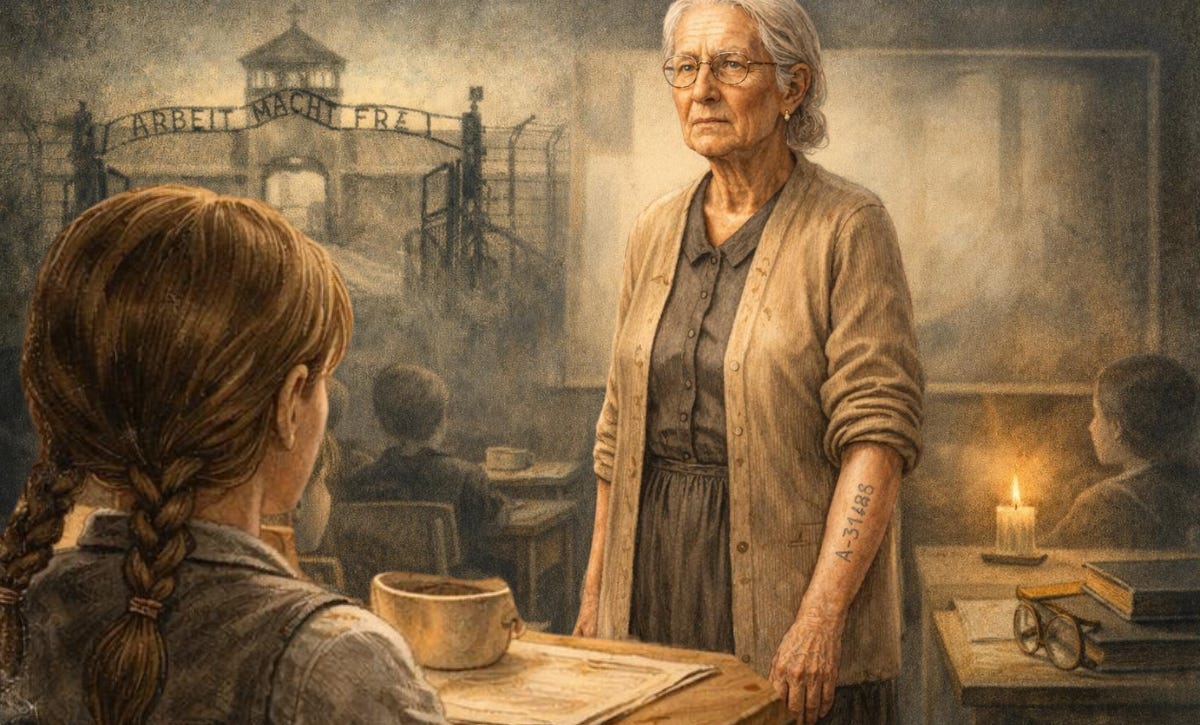
My wife still remembers seeing the number in her third-grade classroom.
Not a lesson plan. Not a textbook chapter. A tattoo on her teacher’s forearm—the mark the Nazis used after reducing a human being to inventory. It was dehumanization made literal: a person stripped of name and individuality, marked so she could be processed and, if necessary, identified after death.
In January, two dates sit close together on the American calendar. Earlier this month, we commemorated the life of Martin Luther King Jr. and the struggle for civil rights. Today, January 27, we mark the day that the Auschwitz-Birkenau concentration camp was liberated in 1945.
Different histories. Similar lessons. In both cases, progress arrived only when moral clarity overcame indifference. January 27 is therefore more than a day of grief. It is also a day of courage and hope—the moment when the world confronted the horror of what had been unfolding across Europe.
The Holocaust was not a generic tragedy or an episode of wartime brutality. It was the systematic attempt to exterminate the Jewish people. By the time it ended, six million Jews had been murdered—roughly two-thirds of Europe’s Jewish population and nearly half of the world’s Jews alive at the time. Entire communities vanished. Languages, traditions, and family lines were erased. The magnitude was not incidental. It was the objective.
The Holocaust did not begin with gas chambers. It began with the conversion of people into categories, and categories into problems.
Sixty years later, in 2005, the United Nations anchored that history to the calendar by establishing International Holocaust Remembrance Day on January 27 and urging member states to commit to education and to reject denial and distortion. Whatever one thinks of the UN today, that moment reflected a clearer consensus than we often see now: that the Holocaust was a civilizational rupture, and that remembering it accurately was not optional.
That consensus is now under strain.
In the United States, the Anti-Defamation League reports record levels of antisemitic incidents, including sharp increases in antisemitism on college campuses—my alma mater, Columbia University in New York City, being one notable example.
At the same time, surveys show that large numbers of younger Americans do not know basic facts about the Holocaust: how many Jews were murdered, why they were targeted, or even what Auschwitz was. Many cannot name a single camp or ghetto, and some doubt that it happened at all. Distance from the event, combined with uneven emphasis in education, has turned what was once lived history into something increasingly abstract.
Abstraction can be dangerous.
The Holocaust did not begin with gas chambers. It began with the conversion of people into categories, and categories into problems. Once individuals were treated as abstractions rather than as human beings, moral limits weakened. By the time mass murder began, much of the groundwork had already been laid.
For years, Holocaust education relied on proximity. My children have been fortunate. Their teachers brought Holocaust survivors into the classroom; men and women who spoke plainly about what they endured. When a survivor speaks, history stops feeling theoretical. You can see it happen: the shift from “this happened” to “this happened to someone.”
My wife’s experience was similar, though quieter and more enduring. One of her teachers was a Holocaust survivor. What stayed with her wasn’t a speech or a carefully designed lesson. It was the number on her teacher’s arm, the residue of a system that sought to erase an entire people by first erasing their humanity. The teacher went on to educate children and build a life with purpose. But the number remained.
That kind of encounter will soon be unavailable. The survivors who visited my children’s classrooms, and the teacher my wife remembers, will not be there for the next generation. There are estimated to be fewer than 250,000 Holocaust survivors today, with half of them living in Israel. Soon, no one will be left to say, in the first person, I was there. What replaces living testimony will matter enormously.
This is where courage reenters the story. Courage, in this context, means insisting on accuracy about what happened and how extensive it was. It means refusing to let the attempted extermination of an entire people be softened into vague language or collapsed into just another historical atrocity. It means maintaining educational seriousness even when attention drifts and controversy intrudes.
Courage did not come early enough in Europe during the Holocaust, or in America during the struggle for civil rights. The lesson from history is that it rarely does.
When my wife describes her teacher’s tattoo, I’m reminded that the Holocaust was made possible by the deliberate reduction of a person to a number. January 27 marks the day the world found the courage to reject that logic. When the witnesses are gone, education will matter more than ever. But the most durable safeguard begins with a simple discipline: insisting, without exception, that this is a human being.
Bion Bartning is an entrepreneur and investor. He is co-founder of the Prohuman Foundation with Daryl Davis and Letitia Kim.

Together, we have made immense progress building a foundation for social harmony. But, we still need your help. A generous donor is matching every contribution to the Prohuman Foundation, dollar for dollar, up to $250,000. Join the movement and double your impact today.
The image of that number on the teacher's forearm is haunting preciesly because it was seen in a normal classroom setting. What made it powerful wasn't drama, but proximity. I've been thinking alot about how testimonial education will shift when that direct witness is gone, and digital archives don't carry the same moral weight as a survivor's presence.