


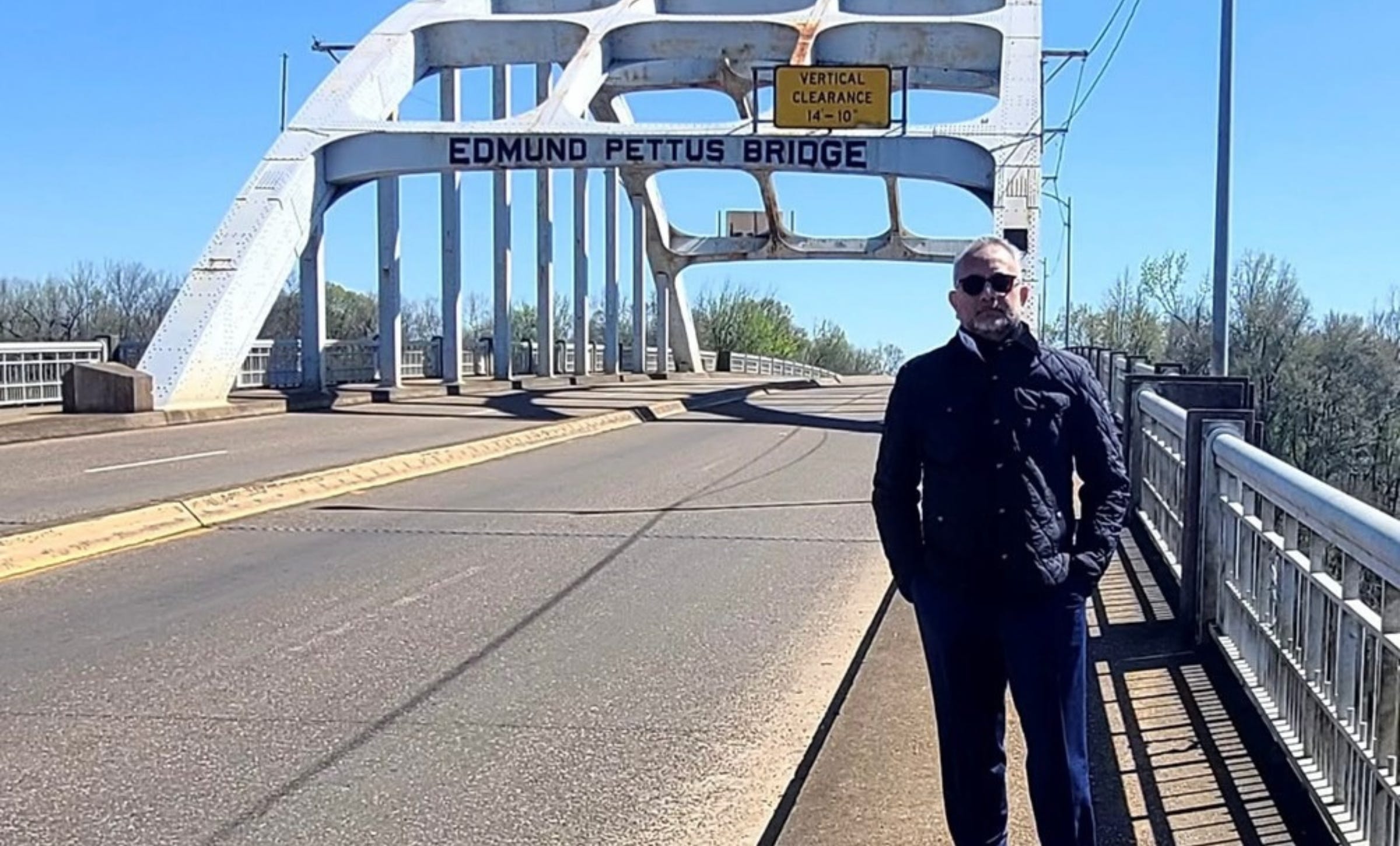
Editor’s Note: In this contribution to our ongoing Renewing the Dream series, Prohuman Foundation advisor and author Neil Ghosh reflects on a personal journey from Kolkata, India, to the civil rights landmarks of Alabama. He invites us to look beyond passive tolerance toward active recognition of the individual—to elevate the person above the category. As this series continues, reflections on MLK’s dream will take on varied forms and perspectives, but each brings us together around a core commitment to the foundational truth that we are all unique individuals, united by our shared humanity.
Earlier this year, I traveled through Birmingham and Selma, Alabama, visiting places where some of the most consequential chapters of America’s civil rights movement unfolded.
I stood inside a church that had sustained people through the struggle for equality. I visited civil rights museums and historic sites. In Selma, I walked across the Edmund Pettus Bridge, where peaceful marchers demanding voting rights were attacked on Bloody Sunday in 1965.
I knew some of this history, but there is a difference between knowing history and standing where it happened.
And then I met Barbara Barge.
Barbara grew up in Selma and was a teenager during the civil rights movement. She remembers meeting Dr. Martin Luther King Jr. as a child. She told me something deceptively simple:
“None of us chooses how we are born.”
We do not choose our family. We do not choose our race or our place of birth. Yet too often we allow these differences—and increasingly our political, religious and cultural identities—to define who belongs and who does not.
Barbara continued: “There’s enough room in this country and in this world for us all to live peacefully and prosperously together.”
For me, that captures the challenge of renewing Dr. King’s dream.
My own journey toward that idea began thousands of miles from Alabama.
As a boy in Kolkata, India, I grew up in a family where speaking against injustice was encouraged. My father was an activist whose convictions eventually landed him in political prison.
After immigrating to the United States, I became deeply interested in the American civil rights movement. I supported organizations working against prejudice and injustice, including the National Campaign for Tolerance, co-chaired by Rosa Parks and civil rights lawyer Morris Dees.
In 2005, I received a certificate bearing their signatures, authorizing my name to be placed on the Wall of Tolerance, an installation recognizing people taking “a personal, public stand against hate, injustice and intolerance.”
For years, I regarded Rosa Parks’s signature as an extraordinary honor. Today, I also see it as an obligation.
Rosa Parks taught me that enormous change can begin with an individual decision. She did not single-handedly create the civil rights movement, nor was her refusal to surrender her bus seat an isolated act; she had been an activist for years. But her courage helped ignite a movement.
As Parks later said, “I knew someone had to take the first step.”
That lesson has stayed with me. But another part of my thinking has changed.
I no longer believe tolerance is enough.
Tolerance can mean putting up with someone despite our differences. Dr. King’s dream asks more of us. It asks us to recognize the inherent dignity of another human being, to see the person before the label.
That does not require agreement. In a democracy, disagreement is inevitable and necessary. We will differ over politics, religion, culture and the direction of our country. Shared humanity does not ask us to erase those differences. It asks us to recognize one another’s dignity.
Selma brought that lesson home in another unexpected way.
There I encountered the physical evidence of America’s conflicting histories: places commemorating the struggle for voting rights alongside reminders of the Confederacy. I found myself asking, what do we do with the history we inherit?
We cannot choose the history into which we are born any more than we choose our race or birthplace. But we can choose what we carry forward.
So, does Dr. King’s dream need renewing? I believe it does, because every generation must decide whether to live by it.
Renewal begins with us: seeing human beings before labels, refusing to dehumanize people with whom we disagree, listening across differences, and taking one meaningful action within our own spheres of influence.
Most of us will never lead a national movement or speak from the steps of the Lincoln Memorial. We don’t have to. Rosa Parks reminds us that someone must take the first step. Dr. King reminds us where those steps can lead.
And Barbara Barge reminded me why we must keep walking together:
“Either we swim, or we drown together.”
Neil Ghosh is the founder of Our Ripple Effect and author of Do More Good: Inspiring Lessons from Extraordinary People, with a foreword by the Dalai Lama. A Prohuman Foundation advisor, he writes and speaks about bridge-building, human dignity, civic responsibility, and the power of individuals to make a difference.

The plaque that marks the spot where Dr. Martin Luther King Jr. shared his dream on the steps of the Lincoln Memorial is fading. So is the brotherhood he called America to build.
Both can be renewed.
Help us reach our goal to restore the MLK marker and advance a culture of brotherhood over division.
Opinions expressed by guest authors do not necessarily reflect those of the Prohuman Foundation. We value diverse perspectives and invite submissions from those who can enrich our understanding of topics close to our mission: to promote the foundational truth that we are all unique individuals, united by our shared humanity.

The timing of this is so fitting, a day after Charlie Kirk’s birthday.