

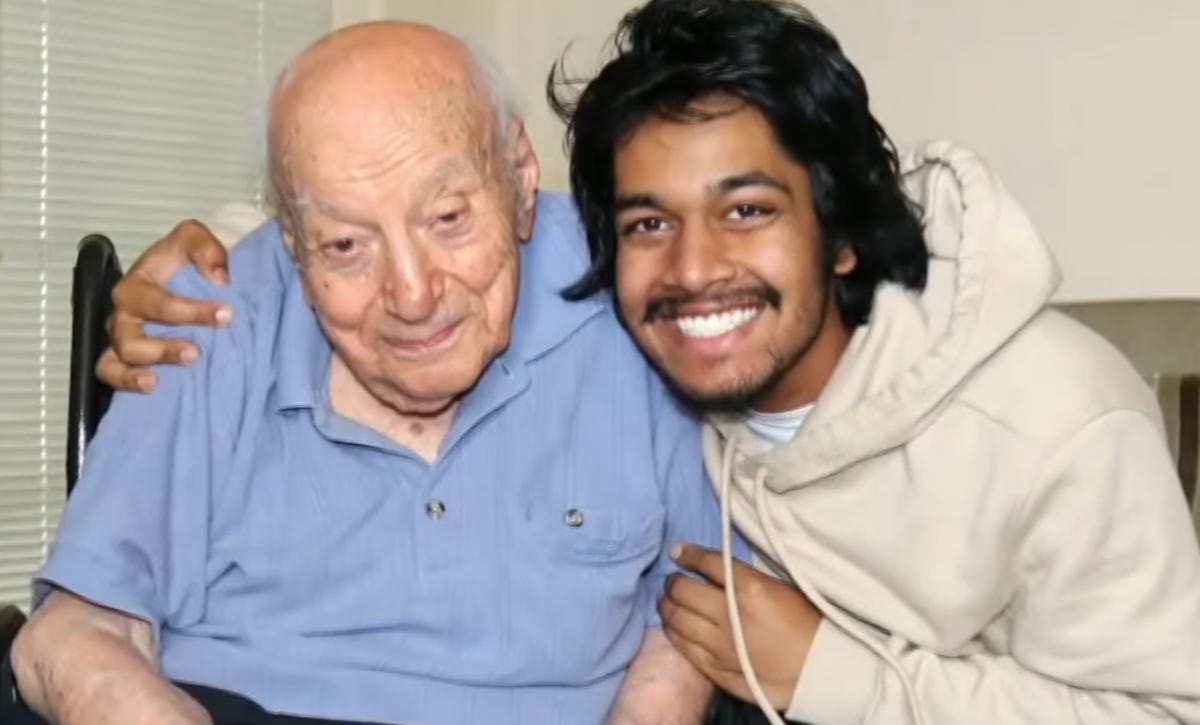
After 10 years and 3,000 interviews, one man’s mission to preserve WWII veterans’ legacy continues
Rishi Sharma has spent the past decade traveling the United States to interview more than 3,000 World War II combat veterans for his Remember WWII project. Sharma, whose parents immigrated from India and who has no military background, believes these veterans serve as a moral compass for the nation and plans to continue preserving their stories. Steve Hartman reports for CBS On the Road.
A decade ago, there were about 700,000 World War II veterans still alive. Today, only about 30,000 remain. And Rishi says when they’re all gone — probably in the next decade or so — America will lose a lot more than just a bunch of old war stories.
“Because for so long they have been the moral compass of our society,” Rishi said. “Just the advice that they impart silently steers the ship of this country.”
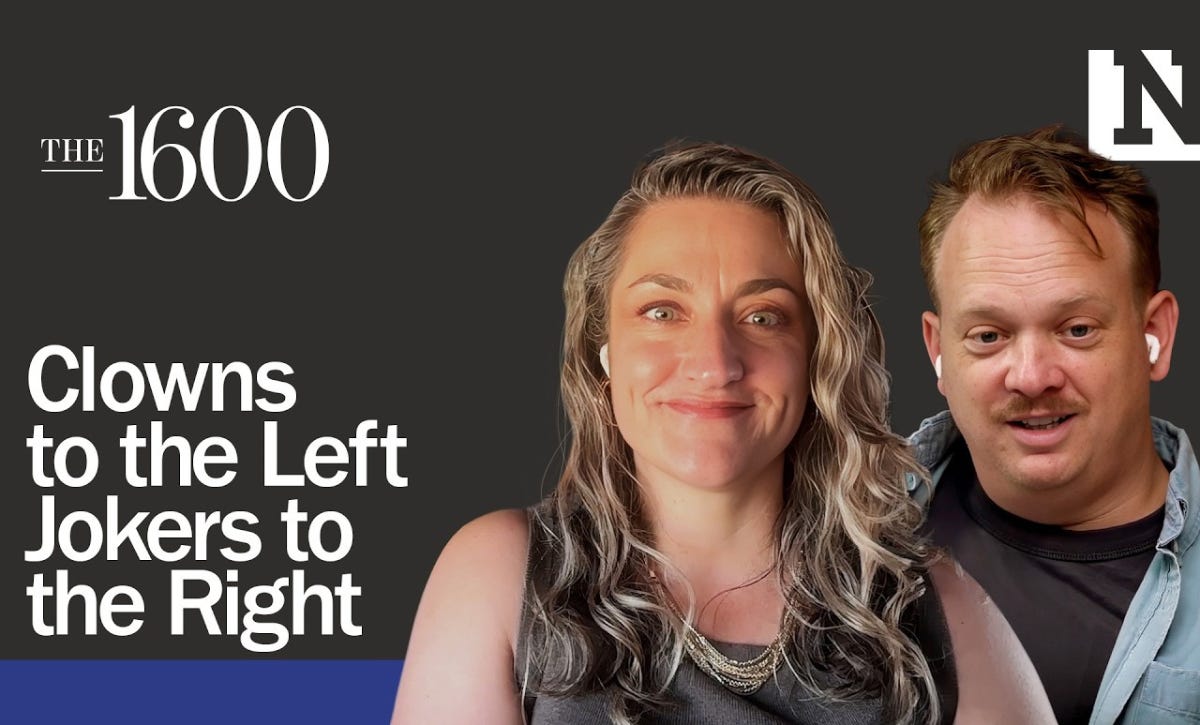
Lauren Hall on Rejecting Partisan Politics
Prohuman Foundation advisor Lauren Hall joined Carlo Versano on Newsweek’s The 1600 podcast to discuss her idea of radical moderation as an alternative to political extremes. She argued that many voters make rational choices based on real concerns that institutions have failed to address, urged four-dimensional thinking over binary divides, and stressed curiosity, humility, and pluralism to reduce polarization.
VERSANO: Being Prohuman is a thing, and it’s something we should all be. But what I mean by that is, like, what you seem to implicitly understand in your work—and you write about this… We are complex people….
HALL: Yeah, I actually serve on the Board of Advisors for the Prohuman Foundation, so that word is coming back. One of the co-founders for that is Daryl Davis…. He’s an absolutely fantastic figure…. I think Daryl’s story tells us something really critical, which is that as a black man, he had every excuse in the world to look at KKK members and say, “I don’t need to engage with you….” He chose the opposite, though. And so the phrase that I think we need to get more comfortable with is ‘curiosity.’

Patriotism Is Good for Us
Clay Routledge writes in his own Flourishing Friday that healthy patriotism builds a shared national identity that unites diverse Americans, builds hope for the country’s future, and supports cooperation and progress without erasing disagreement. He cites new Archbridge Institute survey data showing that most Americans are proud to be American, see patriotism as inclusive, and distinguish patriotism from divisive nationalism.
A positive national identity does more than reduce division. Our research at the Human Flourishing Lab finds that people who are proud of their country tend to be more hopeful about its future. For instance, in a previous survey, we found that 64% of people who are proud to be American are hopeful for the future of the nation, compared to 27% of those who are not proud to be American. This positive association between national pride and national hope holds across political ideology and age groups.

Turning 60...
Writing in The Third Space, Prohuman Foundation advisor Zander Keig reflects on turning 60 with a sense of liberation and gratitude for a nonlinear life and decades of writing, leadership, and personal alignment. Keig emphasizes integrity over approval, psychological freedom through congruence, the importance of authentic relationships, and a forward-looking commitment to contribution.
I’ve traded certainty for curiosity. Ideology for discernment. Performance for congruence. I have found that wisdom rarely shouts. More often, it arrives quietly, asking us to become just a little more honest than we were yesterday.
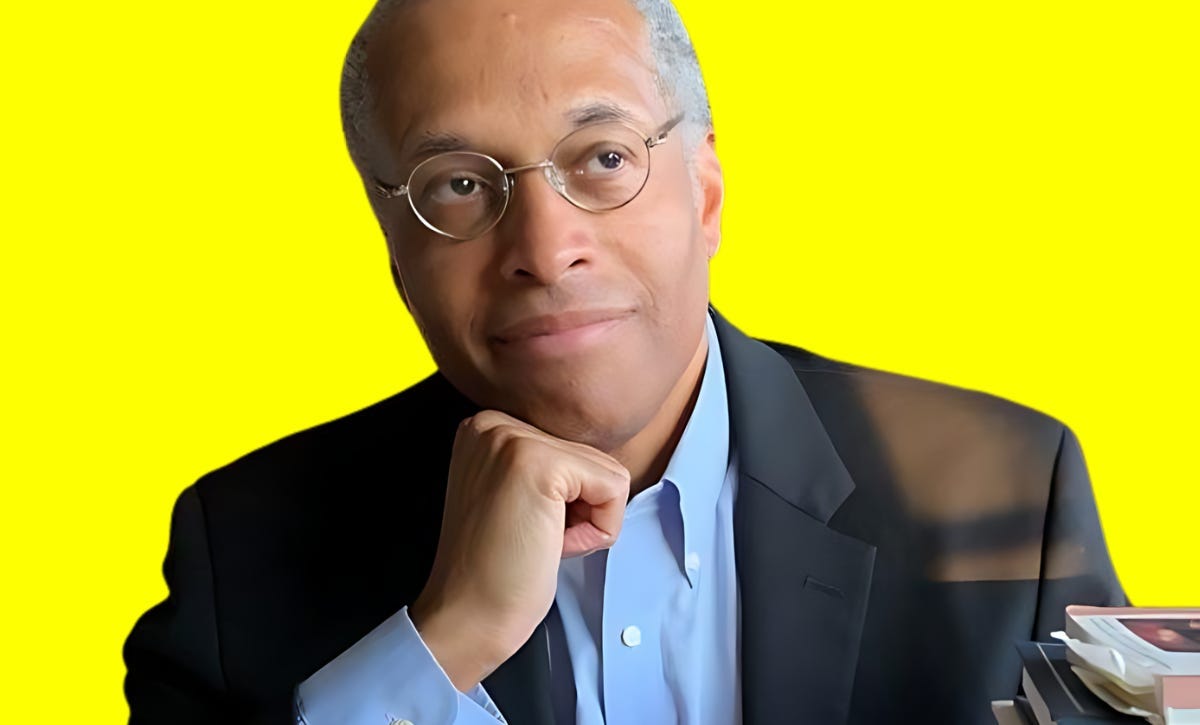
A Novel Meaning of July 4th: From Macon Bolling Allen to quantum computing
Winkfield Twyman writes in Free Black Thought that the deeper meaning of July 4th is America’s enduring faith in “the coming of a better time.” He describes Macon Bolling Allen’s admission to the bar on the eve of Independence Day in 1844, connecting that spirit of possibility to today’s technological revolutions in AI, quantum computing, longevity research, and lunar exploration, urging black Americans to seize these new frontiers for prosperity, contribution, and human flourishing.
The coming of a better time for black Americans on America’s 250th anniversary is no longer the dream of a poor, driven black man from Indiana being admitted to the Maine bar. We are living, this July 4, on the cusp of extraordinary technological advances. A better future lies within our grasp.
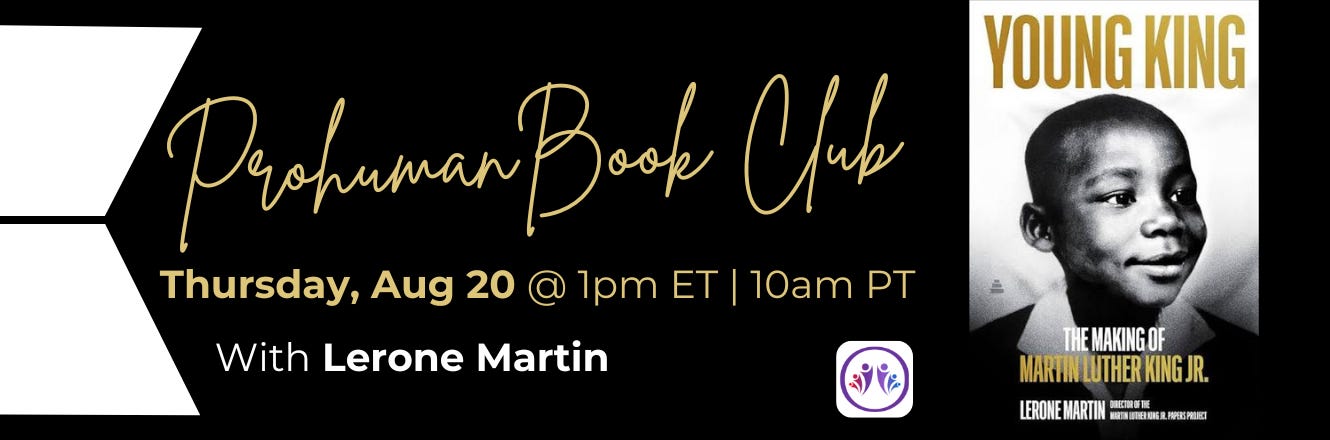
Join the Prohuman Book Club on August 20 for a conversation with Lerone Martin about his book, Young King: The Making of Martin Luther King Jr.
The book examines the formative experiences, faith, and principles that shaped Martin Luther King Jr.’s youth. We’ll explore how individual conscience and character develop, and the Prohuman Approach to cultivating shared humanity and the foundations of constructive civic leadership.

The plaque that marks the exact spot where Dr. Martin Luther King Jr. shared his dream on the steps of the Lincoln Memorial is fading. So is the brotherhood he called America to build.
Both can be renewed.
Help us reach our goal to restore the MLK marker and advance a culture of brotherhood over division.
Opinions expressed in selected articles do not necessarily reflect those of the Prohuman Foundation. We value diverse perspectives that enrich our understanding of topics close to our mission: to promote the foundational truth that we are all unique individuals, united by our shared humanity.
That is incredible. Where can we access his project?