


Civility in a Polite Society
Exploring the Limits of Politeness, and the Possibility of Civility, as We Prepare to Visit Japan next week
Prohuman Foundation advisor Alexandra Hudson, writing in Civic Renaissance, embarks on a comparative analysis examining how Japan and the West each manage the tension between politeness and deeper recognition of human dignity. She explores the pitfalls of both excessive ritual and excessive candor while arguing for civility as the essential disposition that honors dignity and enables flourishing across differences.
Correct form can and should train the heart. But… ritual can become hollow. One can perform the rite and miss the person.
What interests me is the fault line between outer correctness and inner recognition. When propriety is severed from humane regard, the bow remains, but the bond does not. That disconnect between form and inner truth is the tension my work seeks to name….
If a culture overvalues politeness and ritual harmony, it may struggle to surface injustice. If it overvalues bluntness and individual assertion, it may fracture into contempt.

The white-collar office ecosystem is being rewritten by AI — Here’s how we win.
The proper response to AI disruption is not nostalgia. It is preparation.
Prohuman Foundation co-founder Bion Bartning writes in FOX News online that Americans must lead the global AI race by actively shaping and leveraging these tools rather than retreating from the disruption they bring to the professional class. He emphasizes that the path to flourishing lies in treating AI as a powerful amplifier—rather than stand-in—for human judgment and productivity.
There is a profound opportunity embedded in this shift. With AI tools, individuals can accomplish far more than they could on their own. Productivity will rise not because humans matter less, but because they can do more. The advantage will belong to those who are flexible, adaptable and highly skilled at using tools to amplify their own effectiveness.
The transition will require serious investment in education and workforce development. It will demand humility from institutions that assumed credentials guaranteed security. And it will require policymakers to balance innovation with sensible safeguards.
But the proper response to disruption is not nostalgia. It is preparation.

There’s No Such Thing as “AI Policy”
Federalism and tech policy in 4D.
Writing in her Substack, The Radical Moderate’s Guide to Life, Prohuman Foundation advisor Lauren Hall argues that a singular “AI policy” is a misnomer and that a federal moratorium on state-level regulations is a sensible way to prevent overbroad laws. She advocates for a “techno-realist” approach that favors targeted interventions for specific harms, ensuring that Americans can build and refine these technologies before stifling their potential with premature restrictions.
Some of our fears about AI have been overblown so far. Others, like the case of the young man who died by suicide after interactions with an AI chatbot, are real and serious and demand careful attention. But precisely because AI use cases are emergent, because people are finding ways to use this technology that nobody anticipated, you need to see how it’s actually being used before you can meaningfully assess the harm. Regulating in advance of that understanding is like writing traffic laws before the car has been invented.

Why Accurate Ideas Often Face Early Resistance
The social forces that hinder the acceptance of new ideas
In Big Ideas, David Cycleback explains that accurate new concepts often face early resistance and social punishment because human groups prioritize cohesion and status over potentially disruptive truths. He argues that this “social friction” is a predictable psychological response to ideas that challenge established narratives, emphasizing that Americans should evaluate claims based on empirical evidence rather than how comfortably they fit the current consensus.
One reason early accuracy is penalized is status risk. Established views are often tied to the credibility of respected figures, institutions, and group narratives. A challenge to the prevailing view is perceived, implicitly or explicitly, as a challenge to the people and structures that endorsed it. This raises the social stakes of accepting the new claim. Rejecting the dissenter is easier than revising the shared framework.
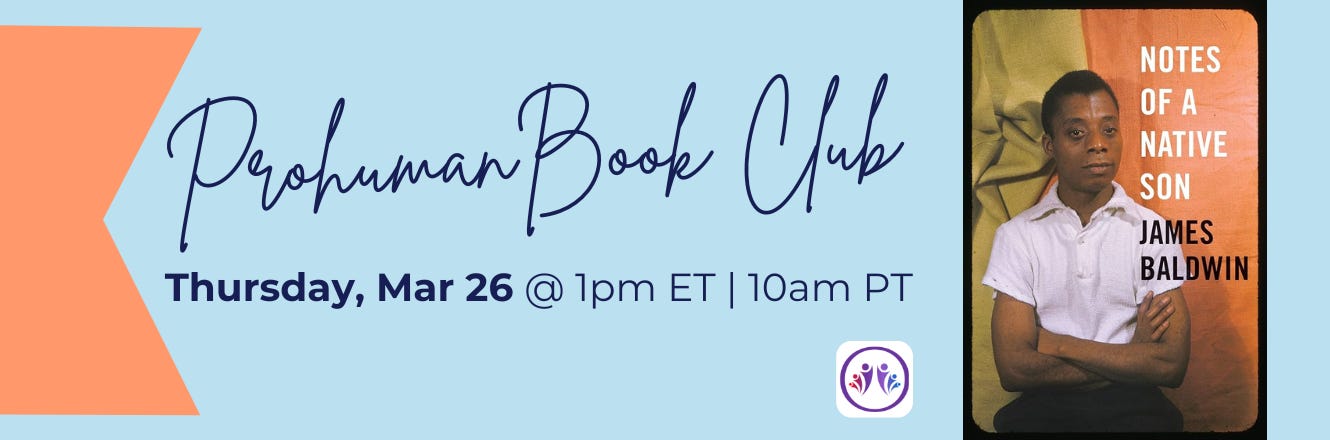
Notes of a Native Son
The Prohuman Book Club meets this month to discuss James Baldwin’s celebrated collection of essays, Notes of a Native Son. Baldwin’s work beautifully and painfully captures a critical moment in our country’s history. We are in for a literary treat and a lively discussion. Join us.

Together, we have made immense progress building a foundation for social harmony. But, we still need your help. A generous donor is matching every contribution to the Prohuman Foundation, dollar for dollar, up to $250,000. Join the movement and double your impact today.
Opinions expressed in selected articles do not necessarily reflect those of the Prohuman Foundation. We value diverse perspectives that enrich our understanding of topics close to our mission: to promote the foundational truth that we are all unique individuals, united by our shared humanity.
:)
There is ritual Harmony, and there is interactive Harmony
Interactive Harmony being an attitude of a willingness to seek pleasing blendings and balancings.