


WATCH: Pure joy.
Rescued hostages Keith and Aviva Siegel learn by surprise of their newest grandchild in a must-watch video that captures the joyful moment. Ruby Sadikman gives context in The Jerusalem Post about the couple’s lengthy captivity following the October 7 attacks and their current humanitarian work.
The Siegels have said that faith in their family’s safety was a major point that kept them going in Hamas captivity, making their daughter’s announcement all the more striking.
“We felt firsthand the meaning of holding on to hope even in the hardest moments,” Keith Siegel said at the SID Israel conference in January.

Kate Brower and Alexandra Hudson on Civility
In a conversation on Kate Andersen Brower’s How She Led to Me, Prohuman Foundation advisor Alexandra Hudson discusses her book The Soul of Civility and her work at Civic Renaissance, defining true civility as a deep respect for shared human dignity that goes beyond mere politeness. Drawing inspiration from her mother and grandmother’s examples of genuine hospitality and magnanimity, Hudson stresses the power of individual character and long-term legacy to rebuild cultures of mutual respect.
BROWER: I think you exude a lot of confidence. Is that something that your grandmother and your mother taught you? I think especially in D.C., you go into rooms that are male-dominated and you’re in a male-dominated field of philosophy and writing—we both are, as historians. Does that impact you? How were you able to move past that feeling of imposter syndrome that I think many of us have?
HUDSON: I’ve never really struggled with imposter syndrome and my mother and grandmother didn’t either. I’m not as good as they are, but… my grandmother.… She would see people whispering, and whereas others—or even I—might be like, ‘Oh, are they gossiping about me? Did I do something?’ She would say to herself, ‘Oh, they’re probably planning a party for me.’ That was her reframe of the moment. So funny. And oh my word… unbelievable unearned confidence.
I’ll tell you a story. One day my mom did a study abroad type experience in the Philippines…. There was this public event where the… leader of the Philippines was there. And she said to herself… [of] the prime minister, ‘they probably want to meet me,’ you know? So she just walked up. She just walked up and introduced herself…. And… in perfect Tagalog, right?
So this tall, beautiful woman approaching you and speaking your language… And of course she got invited to the parties and was ‘in’ with the political elite in the Philippines. And it’s like… who does that? No one does that. But she did.
And she has a whole litany of amazing stories of… that confidence. Worst thing that people can do is say, ‘no’ and brush you off. But the upside is pretty fun if you… risk it.
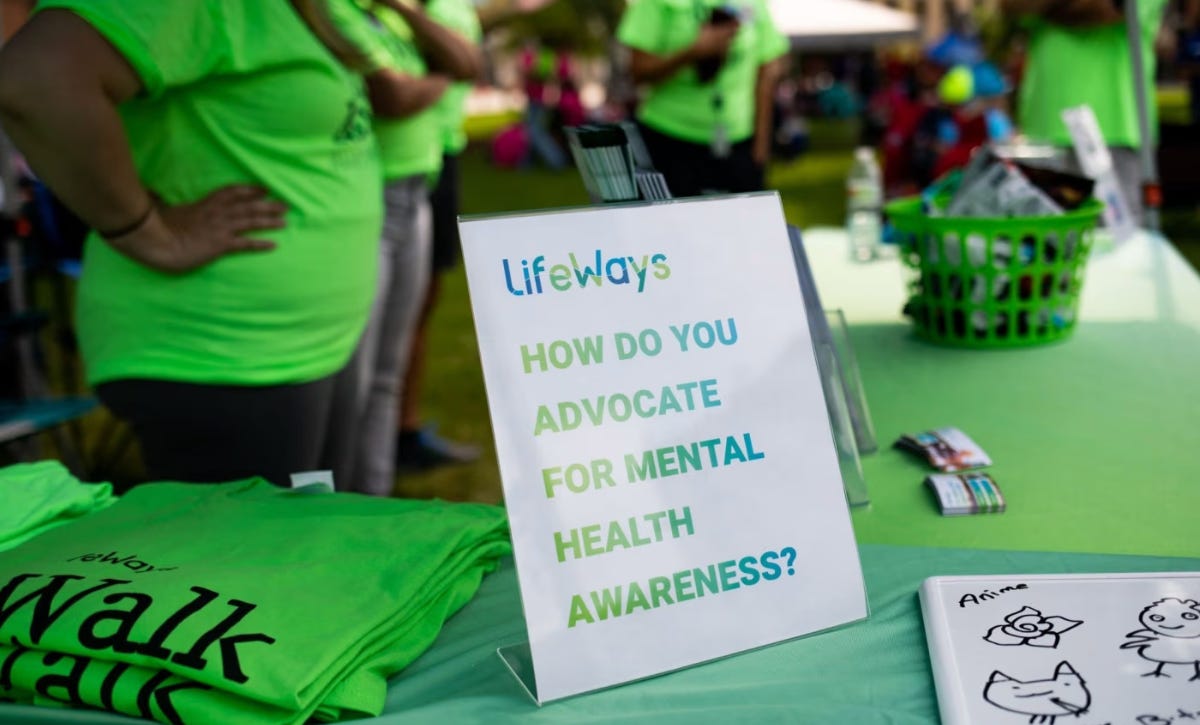
Mental-Health Awareness Can Be Bad for Mental Health
Psychologist Clay Routledge argues in the Wall Street Journal that excessive mental-health awareness campaigns can worsen psychological distress by encouraging people to pathologize mild anxiety and ruminate on problems. He contends that Americans would benefit more from turning outward—through acts of kindness, exercise, and engagement with the world—to build resilience and flourishing.
Instead of encouraging Americans to ruminate on their own concerns, those concerned with mental health should push people to get out of their heads and engage in activities that promote human flourishing. Engaging in acts of kindness has been found to improve mental health more than traditional cognitive behavioral therapeutic techniques—in part because it gets your mind off your psychological problems. Exercise, too, is an excellent way to boost mental health; a recent analysis found that it’s more effective at reducing depression, anxiety and stress than therapy or medication. Even a simple walk in nature can decrease rumination and neural activity associated with mental illness.

Is journalism returning to its origins?
Prohuman Foundation advisor Katherine Brodsky, writing in Random Minds, explores whether journalism is returning to its partisan origins as media outlets increasingly prioritize influence, ideology, and sensationalism over neutral reporting. She questions how to create economic conditions that reward accuracy and depth instead of engagement and outrage.
Many people imagine that journalism has fallen from some golden age of objectivity into today’s landscape of partisan media outlets, influencer commentators, and algorithmic outrage.
But that’s not quite its origin story.
As I wrote in my Skeptic column, journalism did not begin as a neutral profession dedicated to informing the public. It began as a political tool.

Join the Prohuman Book Club on August 20 for a conversation with Lerone Martin about his book, Young King: The Making of Martin Luther King Jr.
The book examines the formative experiences, faith, and principles that shaped Martin Luther King Jr.’s youth. We’ll explore how individual conscience and character develop, and the Prohuman Approach to cultivating shared humanity and the foundations of constructive civic leadership.

The plaque that marks the exact spot where Dr. Martin Luther King Jr. shared his dream on the steps of the Lincoln Memorial is fading. So is the brotherhood he called America to build.
Both can be renewed.
Help us reach our goal to restore the MLK marker and advance a culture of brotherhood over division.
Opinions expressed in selected articles do not necessarily reflect those of the Prohuman Foundation. We value diverse perspectives that enrich our understanding of topics close to our mission: to promote the foundational truth that we are all unique individuals, united by our shared humanity.