


Songwriter’s Commencement Speech on Six Strings and the ‘Life Well-Tuned’
In his UNC Chapel Hill commencement speech, singer and songwriter Eric Church likens a well-lived life to a guitar whose six strings, which he likens to foundational character strengths, stay in tune only when continually tended.
He reminds graduates that all six strings drift in the normal course of life, yet the willingness to pause, listen honestly, and make humble adjustments can restore harmony.
At the Prohuman Foundation—through our programs, which teach courage, compassion, grit, gratitude, optimism, curiosity, fairness, understanding, and humanity—there’s a natural affinity with Church’s vision of tending life’s strings. We hope you enjoy his musical commencement speech as much as we did.
CHURCH: Six strings. Six strings of life and willingness to keep them in tune. Six principles. Six pillars. When all six are in tune with each other, the chord your life makes is full and resonant and true. All six will drift.
Not one or two. All six in their own time, in their own season. Your faith will go quiet when you need it loud.
Your family will get complicated in a way only the people who love you most can complicate things. You will go through hard seasons with your spouse.
Your ambition will hollow out and your resilience will wear thin. Your community will start to feel like an obligation and your world will try to sand down the edges of exactly who you are. This is not failure. This is not weakness. It’s the inevitable universal experience of living in an imperfect world that doesn’t stop to let us tune up. And the difference between a life that sounds like music and a life that sounds like noise is whether you stop and listen. Whether you’re honest enough to hear which string has drifted out of tune and humble enough to make the adjustment instead of just turning up the volume and hoping nobody notices.
Because you will notice. The part of you that knows what the chord should sound like will always notice.
It will not let you go. Life won’t be right until it is tuned. Trust what your heart hears and is telling you about your song.
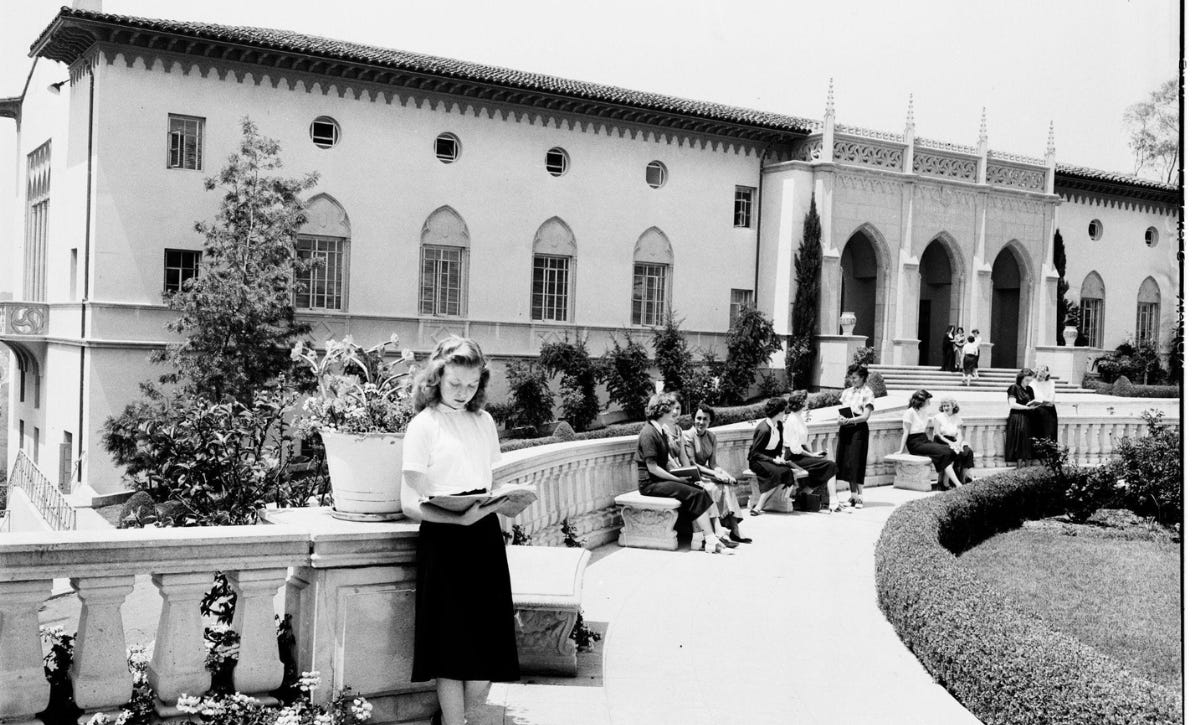
Academia has become unrooted from pedagogy.
Prohuman Foundation advisor William Deresiewicz, writing for Persuasion, argues that colleges have left behind liberal education—training citizens capable of self-government—in favor of job training and activist posturing, speeding the decline of liberal democracy. He urges a return to core general education in foundational texts and a pivot to real excellence so universities can rebuild the wisdom and civic virtues required of a free society.
Liberal education is that form of education that prepares individuals for the exercise of political liberty—in other words, for citizenship. (Its opposite, in Aristotle’s account, is servile education, that which aims at mere utility, the performance of an economic function.) For generations, its importance was a governing idea in American higher education. In 1945, to pick a single milestone, Harvard published what became a widely influential volume, General Education in a Free Society (known from its color as the Redbook)—a pedagogical program, as the war neared its end, for the emerging era of mass political participation. “A republic, if you can keep it,” said Benjamin Franklin, and liberal education, which the Founders also championed, is part of how you keep it.

Who’s Afraid of Classicism?
Prohuman Foundation advisor Jake Mackey writes in Public Discourse that Dan-el Padilla Peralta’s Classicism and Other Phobias makes a valuable case for expanding “classicism” beyond Euro-American Greco-Roman dominance to embrace a wider range of global cultural traditions, yet undercuts itself with a “phobia” lens that treats disagreement as racist pathology. Mackey warns that this identitarian moral psychology and confrontational “barricade” politics risk provoking public backlash, eroding support for the academy, and ultimately undermining the very reforms it seeks.
Needless to say, not all black people will want to sign on to that revolution. Not all will agree that seeing “the fear of Blackness” as “a foundational element of global modernity” is a productive way to think about the world they live in; not all will consent to conceiving of themselves, as Padilla Peralta does, as “colonized intellectuals,” as if there were some authentically “black” mode of intellectualism that an encounter with Plato has deformed and subjugated; and not all will find that “the experience of engaging with the field of classics as a Black-identified individual” results in “abjection.” Nor is it likely that all black people will find compelling the book’s incessant crisis framing—its invitation to imagine oneself as living in a “twentieth- and twenty-first-century ethno-racial Euro-American order” characterized above all by anti-black “predatory violences,” against which reconstructed classicism(s) must not only “affirm and protect Black life” but also secure “safety, protection, and potentially even liberation.”

How courage can bring trust back to the workplace.
TJ Bennett interviewed fellow Prohuman Foundation advisor Maryam Mehrtash on his Desuckify Work podcast. They discuss the relationship between courage and trust in the workplace. Mehrtash, drawing from her childhood as a refugee and corporate experience, argues that courageous thinking restores joy, truth-seeking, and human connection at work, turning fear-based cultures into ones rooted in integrity, respect, and real collaboration.
MEHRTASH: I don’t think that [in order] to build courage you need to be put in circumstances where you’re in fight or flight mode. . . I do believe that it’s a skill. . . And with reps, the more you do it, the more you develop the muscle.
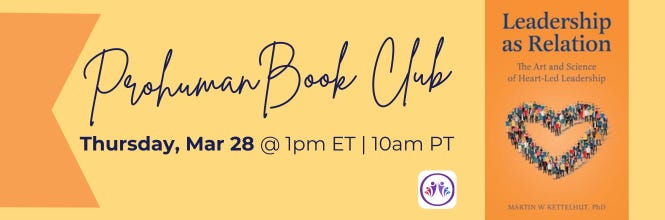
This month, we read and discuss Leadership as Relation by our own Prohuman Book Club host, Dr. Martin Kettelhut. The book asks, “How can we stay faithful to our soul’s deepest longings—personally and collectively—when the forces around us draw us away from the world we aspire to build?” Join us!

Together, we have made immense progress building a foundation for social harmony. But, we still need your help. A generous donor is matching every contribution to the Prohuman Foundation, dollar for dollar, up to $250,000. Join the movement and double your impact today.
Opinions expressed in selected articles do not necessarily reflect those of the Prohuman Foundation. We value diverse perspectives that enrich our understanding of topics close to our mission: to promote the foundational truth that we are all unique individuals, united by our shared humanity.
just found you... great